Categories
Alex Politics

On Radden Keefe’s ‘Say Nothing’ and my childhood in Belfast

1. Slieve Mish

I spent part of my childhood living in Lisburn, a small city just outside of Belfast (the capital of Northern Ireland). While I was too young to remember any of my first stint there, the latter took place when I was between the ages of 11 and 13. I remember those years fondly: we had a large but cold house, and I spent my school holidays hiking in the Mourne mountains, attending Ice Hockey games—Belfast (still!) have the best team in the UK—and shopping at Hollister. But if I came to understand anything from my time in the North, it was precisely how little I, or British people in general, truly understand about our little, yet historically and politically tumultuous, territory across the Irish Sea.

Even some fifteen years after the Good Friday Agreement officially ended the Troubles—Northern Ireland’s thirty-year civil war—its ominous memory continued to hang over my experience. I lived in a military encampment, and it just so happened that my house was next to the perimeter of the base; from my bedroom window, I could just about peer over the towering walls of concrete, corrugated metal, and razor wire, bristling with CCTV cameras, into the civilian neighbourhood beyond. These glimpses were most of what I saw of the place: I was required to flash my ID at guards equipped with full body armour, submachine guns, and attack dogs to even leave my neighbourhood. Once out in public, I was placed under strict orders of clandestineness: speak in a low voice, wear no clothing with the words “England” clearly on it—even my football socks from the 2012 Euros campaign were expressly banned—and do not, under any circumstances, tell anyone what your dad does for work.

Outside of the personal level, too, I encountered the realities of a country still wholly run by deeply-rooted sectarianism. Friend groups, schools, and entire neighbourhoods were wholly split on Protestant and Catholic lines; unsurprisingly, being an Army kid, the youth camps I went to during the summers were entirely attended by the former group. So divided were the cultures that you could generally tell someone’s background from their name alone, or even from looking at their houses: the stereotype suggests that Protestants almost always have blinds in their windows, while Catholics have lace curtains. Speaking to people from the North more recently, I learned an even more ridiculous dividing line: while Catholics tend to keep their toasters on the counter in their kitchens, Protestants would store them in the cupboard (admittedly, I am still unaware of the reasoning behind this particular quirk). A brilliant scene from Derry Girls highlights just how strongly these divides still express themselves in Northern Irish culture—and, indeed, just about how out-of-place I felt as an English boy deposited in this environment.

As a tween, I didn’t really question such peculiarities, many of which now seem absurd when I recount them to Brits my age—as a military brat, you grow used to obediently adapting to new environments. But while I didn’t properly comprehend the full historical context that led to my circumstances, I think what stuck with me was the collective sense of trauma and suppressed violent tendencies that still pervaded Belfast: the uneasy calm of a former warzone at peace for now, but which could rapidly spark again given the right circumstances. That’s the Northern Ireland I knew. It felt like standing atop a dormant volcano.
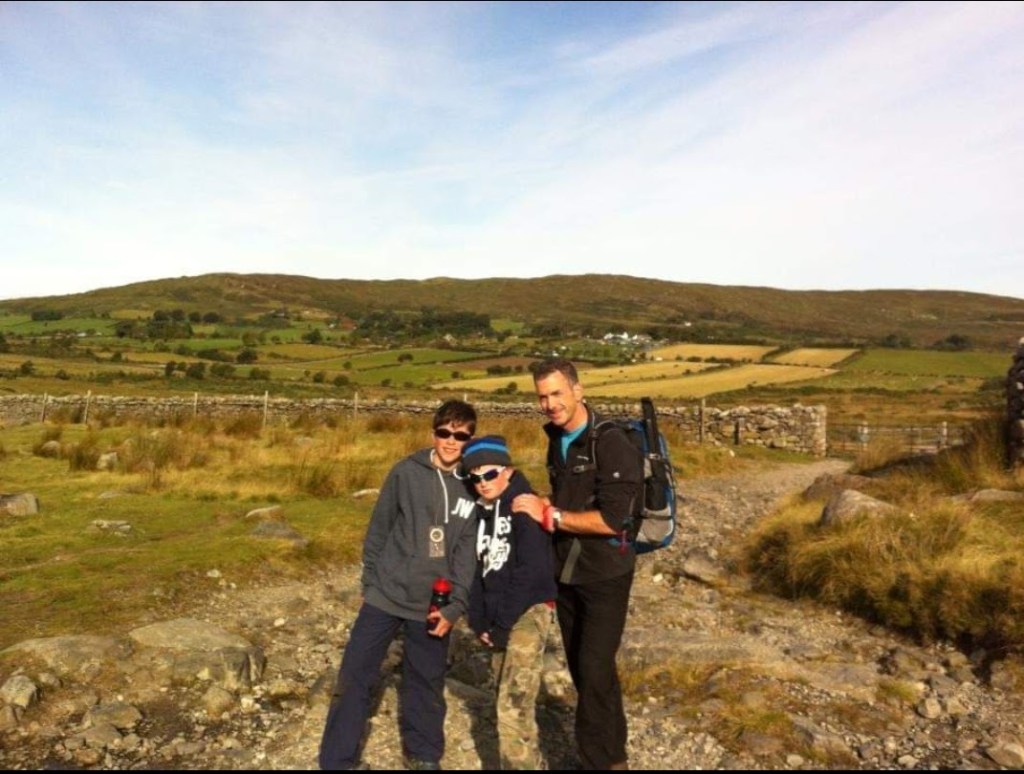
My father, my brother and I in the Mourne Mountains. 2014.

2. Tales of the Troubles

Now, I hardly blame anyone my age from Britain (note: as opposed to the UK) for not knowing much about the Troubles, or, indeed, about Ireland itself. The national History curriculum, or at least what I was taught, relatively conveniently circumvents any and all mention of the UK’s violent, crime-ridden colonial past. Even dealing with colonies such as India and Africa seemed to be relatively taboo, never mind approaching something as recent, as painful, and as outright criminal as many of the UK government’s actions in Ireland from the 1970s to the 1990s; going further back, events such as the Potato Famine or the War of Independence were almost wholly ignored, the latter even when I studied World War I and the interwar period in the UK and Europe. The most mention Belfast ever got was for its role in building the Titanic a century ago. On a broader level, such deliberate educational oversight provides a decent explanation, and a worrying precedent, for Westminster politicians’ pervasive lack of knowledge of and attention paid to Northern Ireland (see Brexit, for an emphatic example). It is a history both incredibly relevant to our own country, and which has the capacity to teach us valuable lessons about similar struggles in the world today. Equally, though, I used to think that one could read all the history books on the North and still not quite resonate with it on a personal level; at least, not in the way that I feel I somewhat can after having lived there.

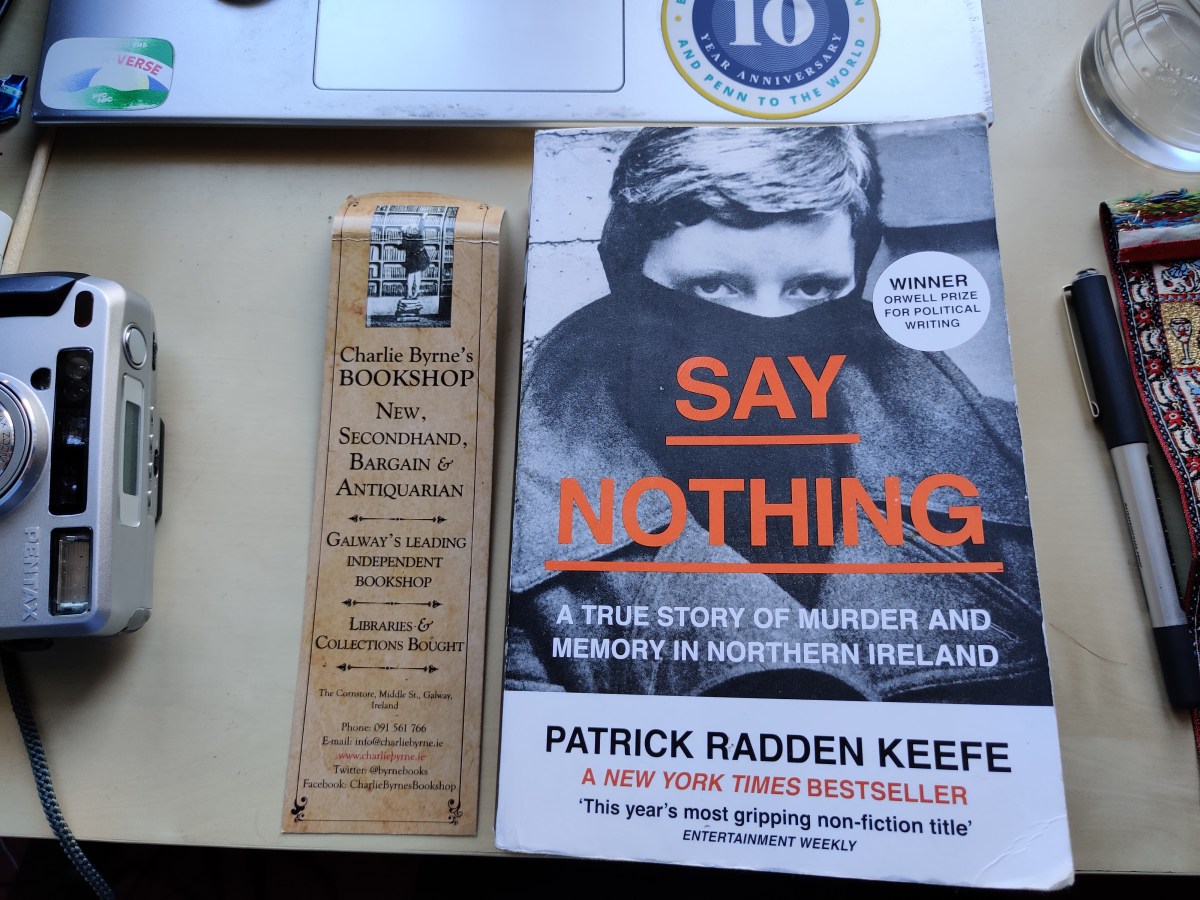
Recent events have changed this view somewhat. In February, my friend Mira came across from the US to stay with me in Edinburgh; having just been in Ireland, she’d picked up an interesting-looking book to give me as a thanks. The book in question was Patrick Radden Keefe’s Say Nothing, an account of the Troubles and the so-called Provisional IRA’s role in them. In short, I was blown away. The thing I think this book executes so masterfully is its choice of tone and structure: rather than merely being a factual history book, Radden Keefe chooses to write in narrative non-fiction. The result is an account of the conflict from the point of view of the complex, nuanced, and fundamentally human people who lived through it. There’s Dolours Price, the daughter of an IRA veteran who moves from peaceful protesting to more radical means. Or Brendan Hughes, the gritty ground commander who sacrifices his marriage and, at times, his morals, for a cause he believes to be unstoppable and fundamentally just. Or Gerry Adams, the later-famous Sinn Fein President who had a murky and contested career in the field. Many more such characters come into the fray (you’ll have to read it yourself to learn about them), but the real narrative hook of the story focuses on the family of Jean McConville, the widowed mother of ten in a mixed Protestant-Catholic family who, one evening in 1972, was suddenly kidnapped by her neighbours and never seen again. Radden Keefe focuses on recounting McConville’s broken family’s story over the following decades, and perhaps unturning some further stones in the mystery of her fate. Using this to provide a centrepoint for the book is an excellent tool for exploring the Troubles’ impact, as well as their memory and how it’s presented, on Belfast’s unwitting and innocent inhabitants.

Now, there is only so much which can be covered without turning into a history textbook: Say Nothing pays little attention to the conflict outside of Belfast and the crimes of loyalist insurgents such as the Ulster Defence Force, while a broader account of how the peace process came to light was also slightly lacking. But the point of this isn’t an accurate historical overview of the conflict: for that, you can go to a textbook or Wikipedia. The book’s aim, instead, is to transport the reader into Troubles-era Belfast by placing them into the stories of the people who lived through it. Aside from this direction allowing the book to provide an account which is riveting and undeniably human—so much so that I tore through the book in two days—it also helps to encapsulate and communicate to the reader that same feeling of division and unease that I often felt when I lived in Belfast (which, incidentally, is the same time that the book was written). That, in itself, makes Say Nothing an absolute landmark. Indeed, I reckon that UK politics would be in a much better position were all politicians—or even everyone—mandatorily forced to read it.

If that doesn’t come as enough of a recommendation, I don’t know what would.
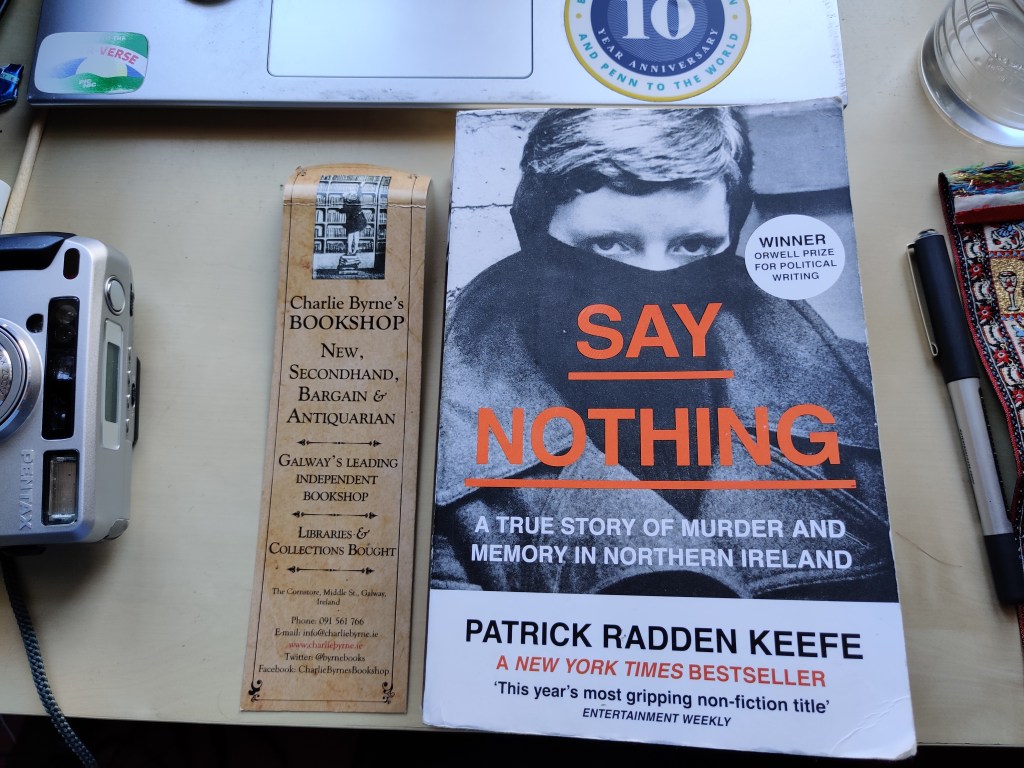
My copy of Say Nothing. 2024.

3. An addendum on Ireland and Palestine

In terms of the lessons we might apply from the Troubles to the modern day, a particular line from Say Nothing really stuck with me. The following is written on p. 259 (in my version):

“Part of the reason that such a process [as truth and reconciliation] was feasible in South Africa was that in the aftermath of apartheid, there was an obvious winner. The Troubles, by contrast, concluded in stalemate”.

Now, I’ve stated several times in the past year that I’m not in the business of presenting concrete solutions to the conflict and occupation in Israel and Palestine: many more qualified and informed people than me have attempted it, and all have failed. But having previously put a lot of weight on South Africa as the best template we’ve got in terms of where on earth to start with a peace process, reading this book gave me a lot of cause for reconsideration. The Troubles, after all, have a lot in common with what we see in Gaza today: an embittered battle between a modernised, Western state army and a generational, rag-tag paramilitary organisation, ostensibly in the name of an oppressed group’s liberation from a foreign force on one hand, and the violent cessation of the rebels’ existence on the other. Neither goal is easily achieved even if it is realistic; war crimes abound on both sides. Crucially, though, outside of the total annexation of Palestine by Israel—an outcome that worryingly seems more and more possible by the day—I don’t see this conflict ending in anything other than a ceasefire and a stalemate. As the Provos knew then and Hamas knows now, overcoming the occupier is impossible; meanwhile, as the UK knew and Israel knows, crushing a rebel movement by force is impossible (though I can say for a fact that this is not the true aim of at least some members of Netanyahu’s cabinet). The issue is, of course, far more complex than this vague outline suggests. But the similarities may render the Troubles one of the best templates we’ve got for working out some sort of just resolution.

As the book details, the Good Friday Agreement was far from perfect. Many victims of the Troubles felt betrayed by its existence, and its terms and spirit have been largely defiled in the subsequent years (cough cough Brexit cough cough). But in providing an adequate political solution focused on amnesty and peacebuilding from both sides, it achieved far more than 30 further years of violence ever could have. Now, I’m not informed enough to offer more of a deep dive into the intricacies of each peace agreement; there are far better resources on that out there. But what I do know is that while the Belfast I knew was divided, tense, and fundamentally haunted by the spectre of its past, at least it wasn’t a bloody warzone. That is the least that kids in Gaza, Kibbutz Be’eri, and beyond deserve right now. Someday, I hope that their stories are told with the same care, and their humanity is as well conveyed, as Radden Keefe has done here.

Now, if anyone has any good book recommendations about potatoes, I’d best get reading…

Buy Say Nothing at the Lighthouse here, or through your local independent bookshop.

Categories
Politics

For Posterity: some thoughts on the morning after

The White House, Washington, D.C. 2022. Photo by me.

Just to clarify what I meant here, a day later: I don’t think Trump is on the level of genocidal maniac that Hitler was. Nonetheless, my point is that while last time was survivable, I fear the instability and suffering that he will be able to cause as a result of his increased unaccountability, in the US and across the world, will be palpable.
—07/11

About six years ago in History class, I studied the fall of a thriving and progressive democracy. One that faced troubles with economic management (which, to be fair, were far worse) which, alongside conservative pushback, led to the rise of a charismatic right-wing populist. A man who staged abortive coups, who baselessly used vulnerable and minority groups as scapegoats for the world’s ills, who promised simple, violent solutions (including economic autarky) to complex problems. A man who infiltrated a right-wing establishment which, after initial rebuke, spinelessly embraced and uplifted him as their leader, fearing for the sake of their political livelihoods that they had no choice but to do so.

Now, comparisons between Trump and Hitler are at least eight years out of date at this point (ask JD Vance). But waking up after five hours of sleep this morning, I wonder if the same mood of listless, confused fear that spirals around my head now was the same that my ancestors felt in 1933. I wonder if my undocumented, queer, and trans friends in the US feel the same disbelief young Jewish Germans felt at their own generation’s brazen sacrifice of their wellbeing in the polls, the same unabashed dread they once felt when they were told they would be disenfranchised, deported, decimated. I wonder if the children of Ukraine and Gaza resonate with the children of Austria, Ethiopia, Manchuria, Poland, when they were told their homes would be conquered, carved up, cleansed.

America today is not Germany in 1933. The latter was a country that was economically destitute and multilaterally sanctioned; the former is the most powerful economy and military in the world. Comparisons, nonetheless, abound. Both have their supporting casts: von Schleicher and Vance the hypocritical lackeys, Hindenburg and McConnell (or even Biden) the cowardly kingmakers. In each case, the stage is now set: far more so than in 2016, any remnants of checks and balances are now eroded. And in the case of Germany, which was fundamentally a far less significant power, it took twelve years to slaughter millions and fundamentally reshape the structure of the world. I’m not saying that we’re necessarily headed in the same direction, but I can’t now say with any certainty that we’re not.

I don’t know where we go from here; I could study two more Politics degrees and still be unable to tell you. But I don’t know how anyone deals with the problem of an unchecked fascist at the head of the most powerful country in the world. We learned from the futility of appeasing Hitler with Putin in Ukraine; with our chief ally, though, my government has already had no choice but to bend the knee. Now, there’s a strong chance here that I’m in a severe spiral and that everything will have the chance to flip back to normal in four years’ time; there’s also a chance that the “normal” I’ve lived my life in will never return again. I can no longer rely on the former. Regardless, History will judge us for our actions and inaction today the same way it has judged our 1930s contemporaries.

All in all, this is either just a bad day or the beginning of the end. Nonetheless, Australia is about the only Western country without a significant fascist movement right now; I remember Sydney as being beautiful around this time of year…

In the meantime, look after each other. We all we got.
—A x
06/11/24

Categories
Featured Politics

Nine common misconceptions about my views on Palestine and anti-Zionism

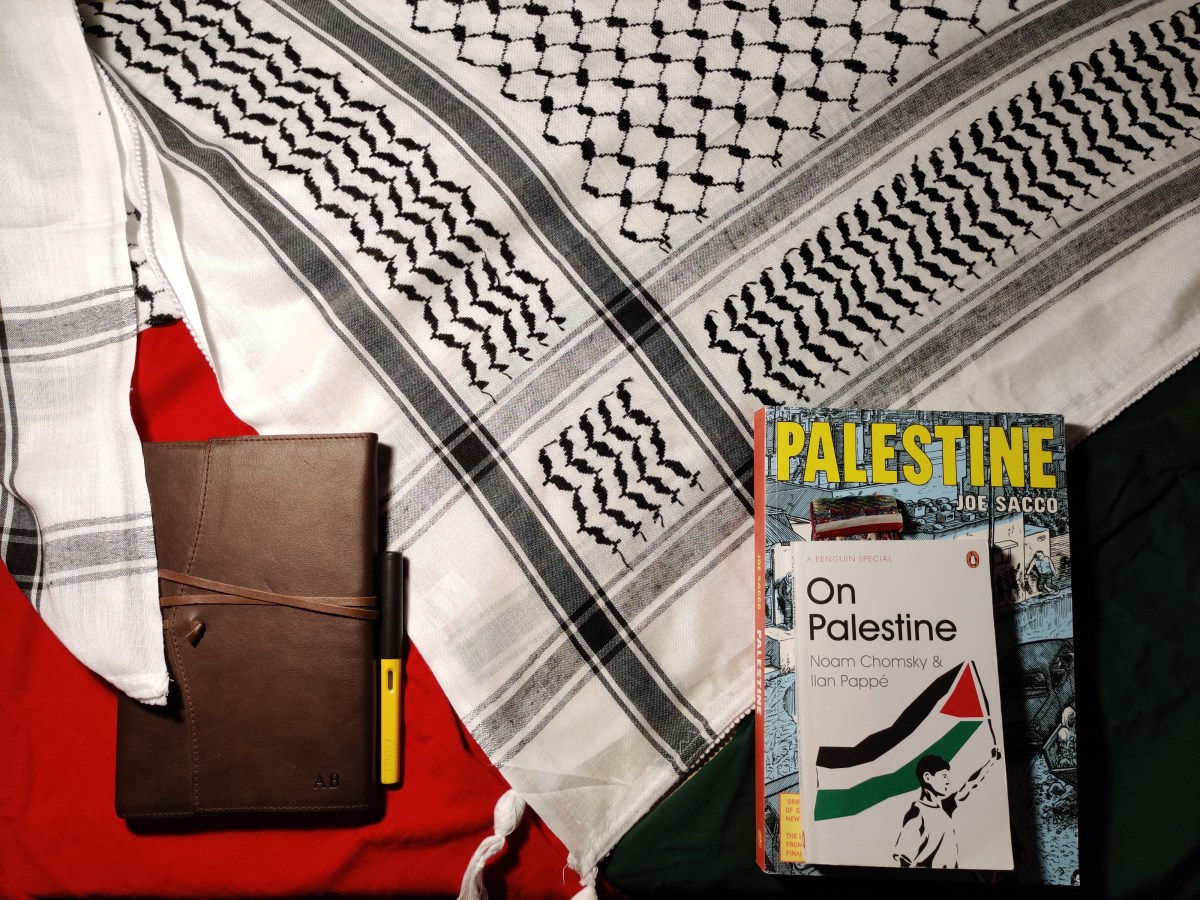
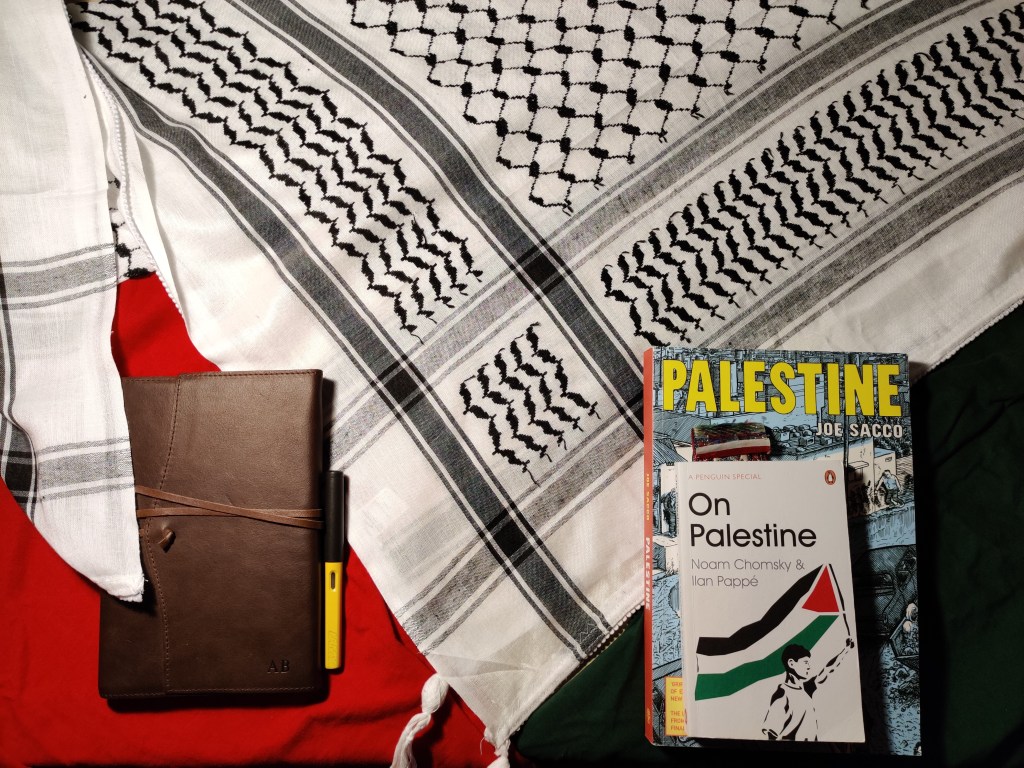
My Keffiyeh at home. Edinburgh, October 2023.

The past two months have been incredibly difficult, both for my friends linked to the area and politically engaged people in the North Atlantic. I sincerely hope you’re all feeling safe.

However, in that time, I have both engaged in conversations and seen others online in which several things are suggested about me and others who share similar stances which are patently untrue. I thought it appropriate to outline a few of them in order to make my views clear.

NB. I’m not going to hyperlink to all of the facts here, but all are things I’ve previously read and can try and dig up for you if you really want to see them.

1. You don’t care about Palestinians, you just hate Jews, Anti-Zionism is antisemitism, etc.

Let me start by making clear the difference here. When I talk about Jewish people, I mean the ethnic group; when I talk about Zionists, I mean the political movement. The two have a lot of overlap, yes, however not all Jewish people are Zionists, nor are all Zionists Jewish. Look at the millions of Zionists in the West loudly supporting Israel and its actions—many of them are not Jewish. Look at Arthur James Balfour, the creator of the eponymous declaration and thus a critical supporter of Zionism, who was not only not Jewish but was also an avowed antisemite (he referred to them as “alien and even hostile” in 1919). In a political sense, I oppose all of these Zionist individuals and groups, and support the many Jewish people (including my friends in the UK and US, as well as organisers for Jewish Voice for Peace and similar organisations) who share my views.

Equally, I acknowledge and am abhorred by rising antisemitism in the West today, and stand unequivocally with the Jewish community in opposing it. Under no circumstances should they be associated with the actions of Israel, or face hatred or discrimination of any kind.

2. There are genocides and war crimes happening all over the world—why do you only seem to care about Israel and Palestine (heavy implication of antisemitism)?

I care about the others, too—I wrote a piece about the Uighur genocide in China a few years ago, which I largely stand by (though my views on the Falun Gong cult have been emphatically enlightened since). What is important about Palestine is both the speed at which people are dying, as well as the emphatic indifference and outright support of governments that claim to represent me and the values I hold dear towards it. The governments of the UK and US are explicitly allied with Israel, and largely support its military-industrial complex—they have the power to change its policies. Moreover, the UK helped to start this mess in the first place: we have a disproportionate responsibility to help fix it. As citizens, we, too, need to pressure our governments to change their tack before it is too late (if it isn’t already, or wasn’t a month, two months, or several decades ago).

3. When you refer to Israel, do you blame all of the citizens of the country for its government’s actions (heavy implication of antisemitism)?

Okay, this one is honestly a bit weird, but I’ve actually had it thrown at me quite a few times. The answer is obviously not, and I am really not sure where you get that idea from. When I accuse China of genocide, I don’t implicate my Chinese friends in that definition; when I accuse the US or the UK of war crimes in Iraq and Afghanistan, I don’t implicate myself, my friends or, indeed, my own family (several of whom were sent there). I am referring to the states and their government, not the citizens: when I say “Israel”, I mean the state and government of Israel, not the citizens of Israel (or Jewish people anywhere for that matter). I hope that’s clear.

Scaffolding on the Royal Mile. Edinburgh, November 2023.

4. Majority states of other religions and ethnicities exist everywhere—why do you oppose the existence of Israel, the only Jewish one, and not others (heavy implication of antisemitism)?

There is a difference between countries happening to have a majority of one religion largely due to historical and ethnographic reasons, and one which enforces it as a part of government policy (I know it’s not in the constitution, but look seriously at their actions). Israel’s current population is created as part of a campaign to form a gerrymandered ethno-state, and this comes at the direct expense of Palestinians. The easiest example of this direction being enacted is the international Jewish diaspora being given the “right of return” to Israel, but indigenous Palestinians not being allowed to enter at all, even if they were born there. What else could explain this?

In a broader sense, I don’t think that biblical or genetic lineage denotes some sort of rightful claim to a land (because if so, Palestinians have just as much right if not more to the place, and I can claim a swathe of land in Kenya, where humanity is believed to have emerged from, and claim my rightful home is there). However, what I do believe is in free movement, freedom from persecution, and the fact that many Jewish people feel a cultural and religious affinity with the area. For all of those reasons, Jewish people should be allowed a home in Israel/Palestine should they so desire it. But that home cannot be forced to be only for Jewish people at the direct expense of indigenous Palestinians, who have the exact same rights (and are being denied all three by Israel at present).

So, I don’t oppose the right of Jewish people to live in the area at all; what I oppose, however, is the creation of an exclusive and exclusionary Jewish state on land they had no right to take in the first place.

5. Why don’t you care about the hostages (heavy implication of not caring about innocent Jewish people ie. antisemitism)?

To reiterate my stance: the hostages should come home. But two major things need addressing here. Firstly, why aren’t we talking about the thousands of innocent Palestinians held in Israeli jails without charge, in a breach of international law, who have been for years (though there are more now than ever), and who regularly report facing torture while incarcerated? And secondly, you should be asking that of Netanyahu’s government, who have been carpet-bombing Gaza over the past two months despite having no knowledge of where the hostages currently are. I’m not an expert military strategist, but I know enough to be sure that their actions do not indicate a primary desire to get those people home—if it was what they wanted, they wouldn’t put a single extra one of them at risk. Many of the hostages’ families have criticised the Israeli government along the same lines.

6. “From the river to the sea” (and other common cries for Palestinian liberation) call for the eradication of all Jewish people (explicit accusation of antisemitism)!!!

Wording in Politics is tricky, because there will always be someone who attempts to twist what you say the wrong way (as I’ve seen from the responses to my recent article in the DP). To be clear: some of those who use that phrase do truly desire that (just as antisemites such as Balfour wanted to get rid of Jewish people by sending them to Israel). But calls for liberation do not necessarily indicate the negation of the rights of others. To use what is a tired metaphor by this point, “Black Lives Matter” never meant to say that white ones didn’t, too: its point was that black lives were treated as somehow lesser than others. In a similar vein, Israelis are afforded the right to live in freedom across the area (and even illegally in Palestinian territory), whereas Palestinians from East Jerusalem, where they are annexed by Israel but not afforded citizenship, to Gaza, where they have lived under a decades-long blockade and now a brutal siege, are not. Calls for Palestinian liberation are rooted in a desire for them to be able to live freely in their ancestral homeland: that doesn’t mean that Jewish people can’t, too. The original charter of Likud, meanwhile, explicitly calls for the entire area to be under total Jewish control.

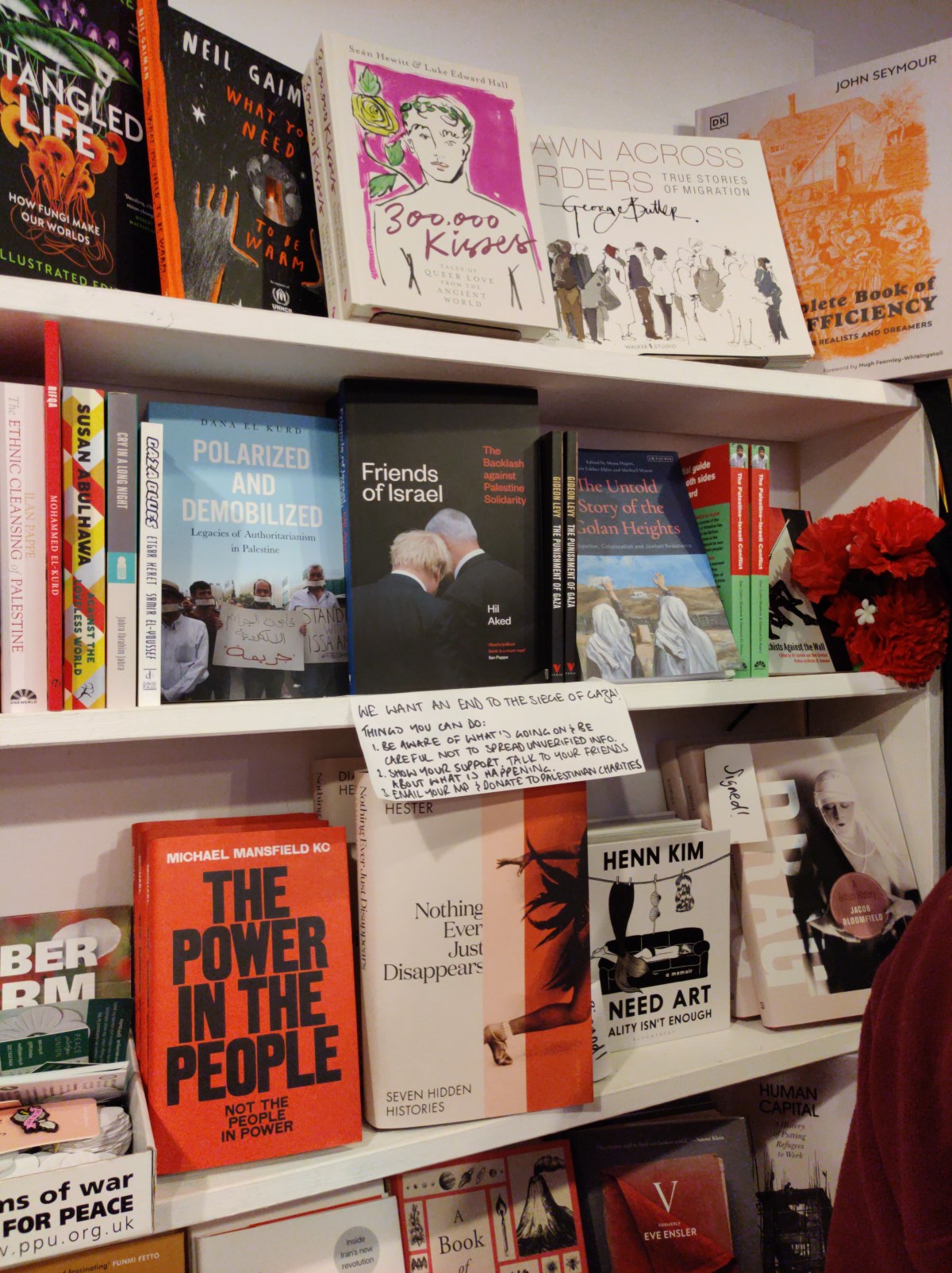
The Lighthouse bookshop. Edinburgh, November 2023.

7. But the Palestinians elected Hamas (implying they deserve this)! Hamas is bad!

Elections last occurred in 2006. Given that almost half of Gaza’s population are children, it’s safe to say that a decided minority of them were able to vote at that point. There is also extensive evidence that Netanyahu’s government has deliberately propped up the organisation for years in a facet of its “divide and conquer” strategy.

I don’t believe in collective punishment (not least because it’s a war crime), and especially not for the actions of a government most of the people did not elect and do nothing to support.

Moreover, Hamas’ violence is not justifiable under any circumstances, but I don’t realistically understand what else you could possibly expect to happen when you limit Gaza’s movement, electricity, food, water, building supplies, etc. while your army can continue to bomb them whenever they want with impunity. It’s a vicious and hugely complex cycle of violence, perpetrated by both sides. However, it’s one that Israel, with its hilariously larger military and financial power as well as its purported democratic values, has the ability and the responsibility to fix. We should hold our allies to a higher standard.

8. Israel is just defending itself (also implying I don’t believe it should be able to)!

I’m sorry, but I can’t take you seriously if you honestly believe that killing 5,500+ children constitutes self-defence. It is, to put it lightly, retaliatory offence. There are other ways of eliminating a threat, such as targeted military raids, that don’t put literal millions of civilians at risk. I grew up in a military family stretching back at least four generations on both sides, and I don’t know a single honourable soldier who wouldn’t risk their own life to save innocent children, no matter where they come from: that’s why they join up in the first place. I wish the Israeli military were the same, rather than explicitly stating the opposite in their policies and actions.

9. This issue is too complex for you to understand: you’re just naïve (and antisemitic) to think you’re informed enough to speak out about it!

I’ve been reading about this issue and following it for several years—I didn’t suddenly start caring on October 7th, and I get my information from academic books and journalists on the ground, not TikTok (as I’ve been accused of doing; I don’t even use TikTok). With that said, I’m nothing even approaching an expert: many parts of it, such as finding an enduring solution to this trauma-embedded and deeply contested area, are indeed incredibly complex. Statespeople of far better standing than I will ever achieve have tried and failed to solve it.

Some things, however, are emphatically black and white: the ones I have attempted to outline here are a few of them.

There is always more to learn about this—on an experiential and academic level, I am far from the most informed on it, and I haven’t covered everything here, but I know enough to tell you that what is going on currently must stop.

I hope you find this useful. Message or email me with any thoughts and responses, and keep having the important conversations with those around you about this. The only way we meaningfully change anything is by uniting together to sway hearts and minds.

Take care of yourselves ❤

—AB, 28/11/23

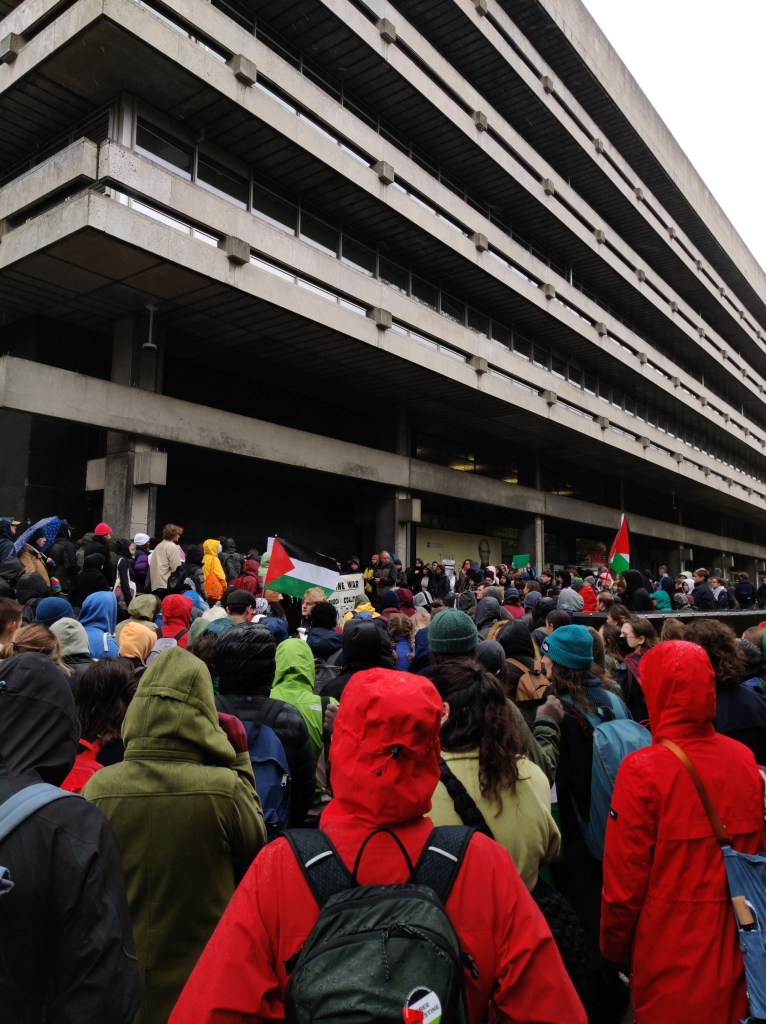
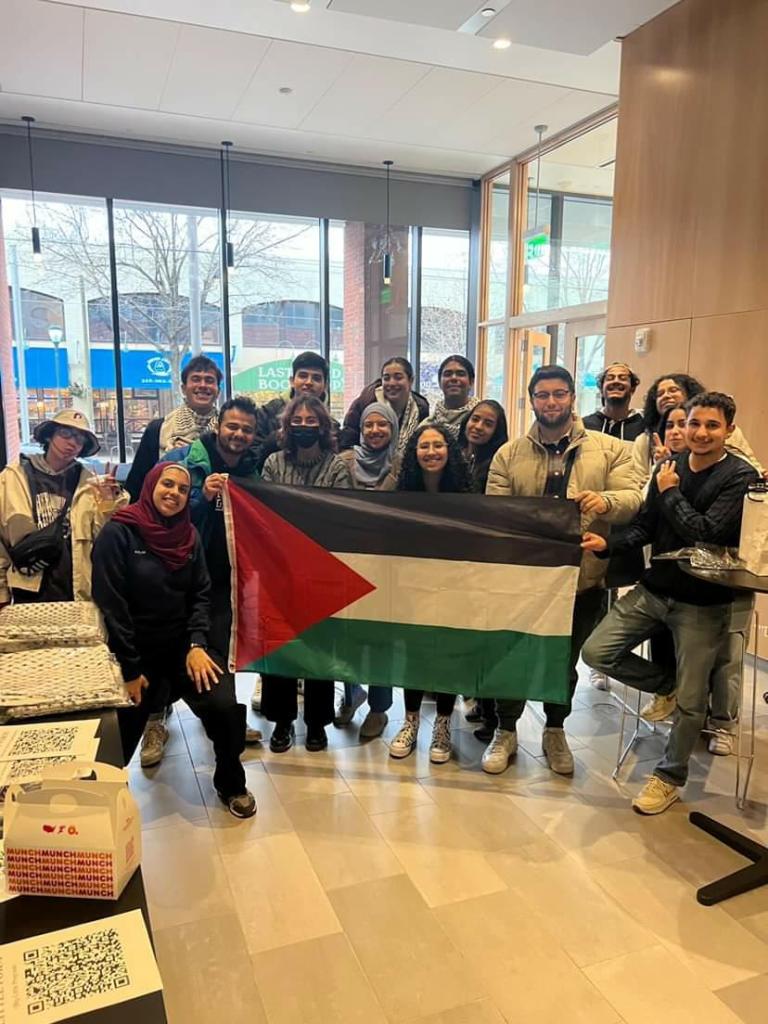
A student-run protest for Palestinian liberation. Edinburgh, October 2023.

All photos used in this article are taken and owned by me.

Categories
Alex Politics

On Anti-Zionism

This is a piece I wrote for the DP in November last year, but never made it out due to Kanye opening his mouth (for the record, I haven’t listened to a Kanye track since). In light of recent events, I thought it best to publish it here now. —AB ❤

Image by me

“Last month, several Zionist groups raised outcry at an incident on Northwestern campus, in which a student op-ed on Jewish pride was posted around campus with the phrase “From the River to the Sea, Palestine will be Free” painted on it in prominent red letters. The Jerusalem Post accused it of being a “use of hateful rhetoric and [a] public, targeted attack on Jewish identity”: in other words, yet another example of unsolicited antisemitic violence from pro-Palestinian activists on an American University campus.

Two important and problematic claims require unpacking here: first, that this public statement was an uncalled-for escalation, and secondly (in a very linked point) that the phrase itself is inherently antisemitic.

The first claim falls apart with a reading of the original article. The piece itself is a beautiful expression of the author’s Jewish pride, and her refusal to meter it in a world that ever seeks to silence and oppress it. It ends with an attempt to reach over the table: to invite those who may oppose her to engage with her, and even to come to a Shabbat dinner with her to better understand her point of view. Especially as a student coming from a country where Jewish culture is much less pronounced, I especially have felt lucky to be able to come to a place like Penn and be able to understand that culture better, and truly appreciate those like her who are willing to let me into their world.

However, her article contains a key caveat, which her Zionist supporters seized on: she calls out the phrase “From the River to the Sea” as “a rallying cry to destroy the entire State of Israel and all of its Jewish inhabitants”. This is the phrase that pro-Palestine activists had emphasised in their response, but an aspect of her piece that had been emphatically ignored by the articles that came out condemning the response to it.

The second claim, which the author also made in her piece, is a much more contentious one that requires deeper scrutiny. Nonetheless, I believe that it mistakenly mischaracterises the entire Palestinian movement and its allies in a manner which aims to paint them as hateful antisemites. The truth is far from this narrative.

The Anti-Defamation League, an organisation which has been increasingly accused of bullying Anti-Zionist groups and wrongfully accusing them of white supremacy, defines “From the River to the Sea” as a phrase defined by most of its proponents as a call for the destruction of Israel and its people. They provide essentially no evidence for this claim. Now, while I’m sure that far too many examples in which individuals have twisted the phrase into this horrible meaning—the Anti-Zionist movement in my own country has faced deep issues with antisemitism very recently—to define this entire movement in this fashion is strongly mischaracterising it. The phrase itself has existed since long before its sub-group of antisemitic adopters. In itself, it calls for a Palestine made whole again: free from the settler-colonialist violence that plagues it and has already killed almost 150 this year, and continues to create and enforce illegal settlements in violation of international law. That Palestine need not be exclusive of Jewish people. Quite the opposite: I believe as much in their right to settle in their ancestral homeland as much as I support Palestinians’ right to return to theirs. But today’s Palestine is characterised by an enforced partition that keeps its citizens from their families, their religious sites and their ancestral homes, and most of all keeps everyone from any sort of lasting, mutual peace. At best, Palestinian ideas of peace requiring throwing Israelis into the sea are outdated; at worst, they have been created and perpetuated by Israeli media.

I’m not attempting to claim that things would be perfect if the roles were reversed and Palestine held all of the power. I’m sure, in fact, that the result could easily involve as intense, if not worse, discrimination against Jewish people. But such caveats cannot permit the current state of unbalanced violence that exists today: not standing up against it would be a betrayal of our morals and our activism.

This mischaracterisation stretches to Penn, too: a Jewish friend of mine told me lately how she had to explain to a passerby that the display of a Palestinian flag on campus was not, in fact, a flagrant display of antisemitism. For a campus and community that stands so strongly for progressive values, it saddens and angers me that were able to be blinded by such naivety over an issue that is so pressing and so lopsided.

I am not Jewish. Nor am I Palestinian. Yet due to this precedent, I feel scared to use my voice in support of Palestine, for fear of my words and my character being twisted into something that I stand as much against as I do Israel’s mistreatment of the Palestinian people. My stance against Zionism in its current state is unequivocally exclusive from my absolute opposition to antisemitism in its increasingly prevalent, multi-faceted and vicious forms. I am tired of the two being convoluted.

That said, I am deeply committed to open dialogue on this incredibly important issue. Please send me an email, a DM, or an invitation to dinner—over my table or especially over yours. Resolution and peace are built over an approach built on understanding, not on division. If you’ve read this far, then I thank you for lending me your ear. Now please let me lend you mine.”

—27/11/2022 – 19/10/2023

Categories
Alex Archive

Archive: Exchange at Penn: A Glass Half Full

My first Correspondent blog post for Penn Abroad. Original: https://global.upenn.edu/pennabroad/blog/exchange-penn-glass-half-full

Coming back to Penn for my second and final semester was weirder, in some ways, than joining for my first. I was lucky enough to get the chance to go home for Winter Break; after a 24-hour trip through New York, Boston and London, getting back to my parents’ in (Old) York, the familiarity of being back in the UK after having spent four months on this incredible whirlwind journey across the Atlantic was jarring, to say the least. Nonetheless, it was lovely to be home again; after rediscovering both the Tesco meal deal as well as the Nando’s Sunset burger (if you know, you know), taking a trip back to Edinburgh to see my friends, and decking my family out in fresh Penn merch, I felt refreshed and ready to get the most out of the rest of my time here.

As I wrote in my recent article for the Daily Pennsylvanian, though, the cultural reset of returning to the Penn Bubble takes a minute to adjust to. More than anything, a lot of things were set to change in my life here: I had a new room in Gutmann College House and new roommates along with it, new classes to start and clubs to join, as well as having to readjust my social life after a lot of my closest friends either went back home having finished their exchange here, or had left Penn to go on their own adventures abroad.

However, it was super exciting to see the rest of my friends again, and getting back into the exciting business of life here never takes very long: I absolutely adore my roommates, I’ve already made so many new friends, and my schedule new schedule is very solid, though I do seem to spend about half of my time studying with friends in the Williams Café. On catching up with people after a few weeks apart, one question I seem to be asked a lot is how I feel about being halfway through my exchange, with less than a semester to go at Penn. Initially, having been so preoccupied with reorientating myself on coming back, this wasn’t something I’d really given much thought to and so wasn’t really sure how to answer.

At first, the thought of already being halfway through my time here was more than a little terrifying. I’d had the absolute time of my life in my first semester: I’d fallen in love with the enhanced sense campus community, incredible sporting and academic facilities, and much more personal teaching style delivered at Penn. As much as I absolutely adore Edinburgh and couldn’t wait to go home next year, I didn’t want my time here to end. And while that end didn’t feel quite imminent yet, I’d be lying if I claimed that my first reminder of its distant existence didn’t shake me a bit.

Equally, though, the more I’ve thought about it, the more my perspective has changed on the time I have left, limited though it is. Thinking back to all I’ve been through since I arrived last August, I’ve already accomplished and experienced so much: from blaring my pride for my newfound community on Homecoming weekend, to the chaos of running a conference for 500 people in downtown Philadelphia with the International Affairs Association, one of the clubs I’m in here, even down to the times I’ve simply smiled to myself while hurrying to class down Locust Walk, taking a second to marvel at and appreciate that I’d actually managed to make it to this beautiful and exhilarating place.

With all of that context in mind, looking forward to the end of my time here from the midway point suddenly became a lot less daunting. Yes, I do only have a few months left, but if those few were going to be anything like the ones preceding them, then I know I’ll be in for the time of my life. Rather than fearing the end, I’ve determined, I am going to make sure I enjoy and appreciate every second of my Penn journey while it lasts. That, I think, is what an exchange should be all about.

Categories
Archive

Archive: We are all visitors

My final piece and “Farewell Column” at the DP! Original: https://www.thedp.com/article/2023/05/alex-baxter-farewell-column-2023

“A year is a long time.”

That’s a phrase that my friends often echo back at me when I bring it up mid-conversation. As my exchange year at Penn comes to a close, I’ve been reflecting a lot on the experience of being here for what is proportionally a very short period, but what to me has simultaneously felt like both a lifetime and an instant. But what I’ve realised is that by the time we reach the end of what is, for everyone, a relatively fleeting visit to Penn, most of us feel the exact same way.

When I was a first-year back in Edinburgh, my friend sent me this article by the late Marina Keegan, which she wrote upon leaving Yale shortly before her tragic death (and which you should absolutely read). She describes the sense of belonging she felt on campus as “the opposite of loneliness”, for lack of a better word. While I thought the article was beautiful and loved the concept, it wasn’t something I quite understood on an emotional level at the time.

Little did I know that that was exactly what I was subconsciously looking for when I applied to attend Penn almost two years ago. I understand now that what always drew me to American college was how the experience is so centred around community. We (or you, I suppose?) have a real pride in our institution, conveyed through school spirit events, excessive merch-wearing, sports fanaticism and more, which doesn’t exist at all in the UK aside from at Oxford or Cambridge. I wanted to feel like I was a part of that: the emphasis of my application essays was on making my mark here just as much as any normal student would.

But what I was worried about was that I would be limited by my temporary status as a “visitor,” and I wouldn’t be able to truly fit in with everyone who goes here full-time. Nonetheless, I soon realised that I needn’t have worried at all: just like all of my first-year and transfer compatriots, the Penn community has accepted me with open arms. The DP, specifically, has been a source of so many incredible memories: from the thrill of seeing my articles in print, to donning a press pass to skip the lines and cover events, to simply debating issues on campus with the incredibly well-informed and diverse group of perspectives in the Opinion department. Between here and all of the friendships, classes and clubs I’ve been lucky to be involved with across campus, I truly feel that I’ve found my place here. All of us have. It’s been everything I’d hoped for.

Now, less than a year later, I get to experience the flipside to joining with the new students: wrapping up and preparing to leave alongside the graduating seniors. It’s a deeply bittersweet experience: final GBMs, new execs and senior send-offs, outgoing parties. Your final lecture. Your final paper or exam. Your last stroll down Locust Walk.

More than reflecting on my final interactions with what I’ve spent months or years taking for granted, I’ve found the oddest experience to be Quaker Days. Watching the fresh-faced class of 2027 come in and gaze in wonder at our campus, many of them for the first time, served as a stark reminder that my Penn experience is ending just as theirs begins, and that our paths here will never really cross. 

Leaving Penn is equal parts daunting and exhilarating. But having spent so much time and effort cementing my place here, it’s disconcerting to me that come August, it’s simply going to move on without me. Nothing has ever made me feel more like a visitor than that.

Coming to terms with that process, though, has reminded me of just how much this place means to me. I wish I could argue to Marina Keegan now that to me, there is a word for the opposite of loneliness: connectedness. That’s what I’ve found, what we all find, at Penn. And no, I don’t just mean connections on LinkedIn: I mean that community which stretches far beyond our physical and temporal presence on campus (even if I don’t get to officially become an alumnus). It’ll be there every time we put on our P-sweaters or our Penn caps, every time we return for homecoming or with our families, every time we reminisce with our former peers, and every time we cheer when Princeton loses. It’s a tattoo on my heart that I will wear with pride wherever I go.

Everyone’s time to leave Penn eventually arrives, whether it’s after one year or four. But what’s truly important is that Penn doesn’t leave us: though our names may become forgotten on campus after a while, the memories that we forge, that feeling of connectedness that we find, persists forever. Though my year here has been more like an instant in the grand scheme, it’s the impact it’s had on me that will be sure to last a lifetime. 

To the class of 2023, my class of 2024, and all those who come after: cherish your, our, connectedness. It will be the greatest and most enduring part of your visit here. 

Thank you for sharing it with me.

Categories
Archive

Archive: Students First, Adults Second: the difficulties of outgrowing the Penn bubble

My most successful piece at the DP! Original: https://www.thedp.com/article/2023/02/students-first-adults-second-penn-responsibility-bubble-privilege

As an exchange student here at Penn, I’m often asked by people here and at home about the differences between the UK and the US. While I could get into a million minute details, my prime example is the so-called “bubble” which arches over Dunning-Cohen Champions’ Field at Penn Park, where I train with the Ultimate club twice a week. Penn’s capacity to put up such a structure for its students demonstrates the incredible calibre of the facilities here, the likes of which we simply don’t have in the UK. When I sent my family videos of the inside, they were astounded.

That aside, one question I’ve never been able to answer properly is what I think about living in Philadelphia. The reality, I have to tell people, is that I live at Penn, not in the city. Like the one above Dunning-Cohen, there is a similar, societal bubble which arches over Locust, cutting us off, to an extent, from the outside community. While the extent to which we’re catered for here massively simplifies our lives, the consequences of that treatment at Penn and beyond may be more far-reaching than we realise.

Coming from Edinburgh, specifically, this concept of an entirely centralised campus area was a very new one to me. My university at home is spread throughout the entire city, with four campuses and classrooms, sports facilities, libraries and more dotted around in-between: while you could get across the entirety of Penn’s campus in a 15-minute stroll across the length of Locust Walk, getting from one end of Edinburgh’s to the other takes about 20 minutes in a car, or 40 on the bus (which, at least, are free for students). We don’t have a university-owned housing requirement. Instead, students live in apartments alongside Edinburgh’s other residents, dotted all around the city. I never even took out a dining plan, though my cooking abilities remain questionable.

As a friend here put it to me lately, the result of this style of living, which is far more decoupled from one’s university, means that people attending university in Edinburgh and across Europe are “adults first, and students second.” Here, it feels like the reverse is true. While it exists through no fault of our own, the Penn bubble doesn’t just separate us from the outer community—it stops us from having to exist as functioning adults, too. When you think about it, all of us live within a roughly 10-block space where everything is catered for: gyms and sports facilities, supermarkets, dining halls and restaurants, bars and even a brand-new Target on the way. And besides, if we can’t find something within those few blocks, we can always order it to the Amazon lockers by the next day.

While the convenience allows me to get so much more work done at Penn, I ultimately have to do very little for myself. I feel like a high schooler again: able to be busy all day between classes and clubs and coffee chats, yet never having any sort of need to leave the University City area and integrate into Philadelphia itself. I enjoy the comfort of campus life, but being thrust into reality (while more than slightly underprepared) in my freshman year at Edinburgh taught me so many valuable lessons about motivation and independence. Whether it was learning to fix all sorts of household items when they break since I didn’t have maintenance to complain to, balancing my class schedule with a grocery run 20 minutes from home, or getting a bar job, not to bolster my LinkedIn, but because I had bills to pay. Learning how to handle yourself as an adult is a key part of the college transition, and of our personal development, that the Penn bubble effectively stifles.

Beyond the fact that I just think it’s a shame, the fear I have is that this same sheltering persists beyond our time here. When we choose careers with companies that similarly cater for our transport, meals, and even gym and spa memberships, we carry along that fundamental disconnect from the common experience that we have on campus. And when I see my classmates, as I’m sure I will, in positions of power and influence some 30 years from now, I worry that the decisions they make will be formed from a superficial, rather than a truly experiential, understanding of how our neighbours from West Philadelphia and beyond live. That sense of empathy for those around us will make us better leaders and should, ideally, be instilled in us through our time living here in the city. Penn’s isolation from the outside, though, renders that much less likely to happen. That sets a worrying precedent, and one that all of us need to contend with.The Dunning-Cohen bubble supports itself due to the air pressure within being markedly higher than the outside. This makes entering and exiting through the airlocks a relatively jarring experience—every time, my ears pop. I’ll never get used to it. This, too, is how it sometimes feels entering Penn’s societal bubble: a weird, pressurised space, totally sheltered from the winds outside. While being inside is easier—throwing a “flying disc” in a winter storm is ill-advised, after all—I always feel relieved when I step out into the crisp, evening air after practice, ear popping aside. Though I adore living here, I’m glad to be cognizant of just how strange and unlike the adult world it is. While the bubble’s all-encompassing nature makes it hard to burst while we’re in it, it’s that awareness that is the first step to outgrowing it.

Categories
Archive

Archive: Patagonia Privilege: The On-Campus Housing Rip-off

Original: https://www.thedp.com/article/2023/02/patagonia-privilege-gutmann-rodin-penn-college-house-inequality

The day I was accepted into Penn remains one of the most exciting days of my life: the culmination of years of work aimed at getting an exchange offer at one of the best schools in the United States and, indeed, the world. But while the thrill of coming here was incredible, the sobering financial reality of studying here quickly began to set in. I was soon having to explain to my parents that unlike my friends going to other US schools, who could live in private accommodation, I had no choice but to pay almost $12,000 (about $1300 a month) for Penn housing. The average rent at home sits at less than half of that. And what was worse, there was a chance I’d have to share a bedroom, something that students rarely have to do in the UK.

Penn’s housing system requires that all first-year, sophomore, transfer, and exchange students live on campus, while other students are given the option to stay or leave. While Penn’s website suggests an open choice of college house, the reality is that rooms are allocated via a lottery in which students are randomly given a time slot to choose rooms. The living situation of literally thousands of students is left up to pure chance, leaving many of them dissatisfied and miserable. Now, were all of Penn’s living locations of roughly equal quality, this system could at least be argued to be equitable. The reality, though, is that some lucky students live in luxurious, brand-new housing while others live in buildings which are frankly run-down and outdated. 

As for me, my chances at this lottery turned out to be even worse than I’d imagined. Exchange students don’t even get to apply for rooms until June, many months after full-time students choose theirs. The result was that we were left with the rooms that nobody else wanted. So though I had obviously put the then-called New College House West as my top choice in the hopes of getting my own bedroom, I ended up in a tiny, two-person, shared-bedroom apartment in Rodin

While Rodin was average but tolerable, it wasn’t until I visited some of my friends’ apartments in the newly-named Gutmann that I truly understood the extent to which I was being ripped off. They were living in a beautiful, brand-new building with single bedrooms, spacious living areas, study rooms, and an exercise suite to boot; meanwhile, my shared room barely had space to breathe in, never mind any semblance of privacy, and my shower took about a minute to heat up every morning. 

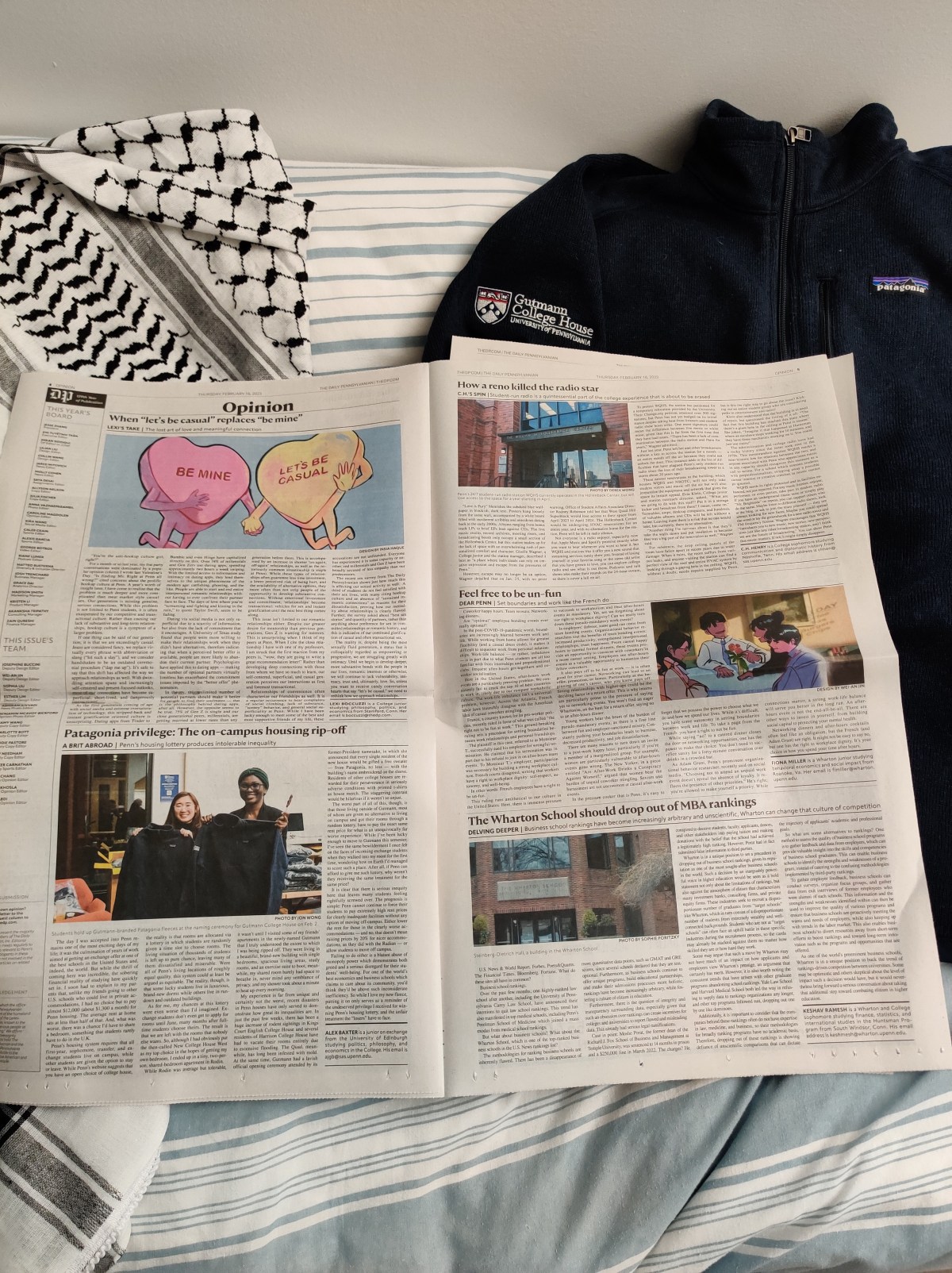
My experience, though, was far from unique and certainly not the worst: recent deteriorations in Penn housing have only served to demonstrate and exacerbate how great its inequalities are. In just the past few weeks, there have been reports of a huge increase of rodent sightings in KCECH and of several residents of Harrison having to vacate their rooms entirely due to extensive flooding; the Quad, meanwhile, has long been infested with mould. In the same time period, Gutmann had a lavish official opening ceremony attended by its ex-President namesake, in which she announced that every single resident of the new house would be gifted a free sweater—from Patagonia, no less—with the building’s name embroidered on the sleeve. Residents of other college houses are rewarded for their perseverance in seriously adverse conditions with printed t-shirts as house merch. The staggering contrast would be hilarious if it weren’t so unjust.

The worst part of all of this, though, is that those living outside of Gutmann, most of whom are given no alternative to living on campus and got their rooms through a random lottery, have to pay the exact same rent price for what is an unequivocally far worse experience. While I’ve been lucky enough to move to Gutmann this semester, I’ve seen the same bewilderment I once felt on the faces of incoming exchange students when they walked into my room for the first time, questioning how on earth I’d managed to score a place there. After all, if Penn could afford to give me such luxury, why weren’t they receiving the same treatment for the same price?

It is clear that there is a serious inequity here that results in many students feeling rightfully screwed over. The prognosis is simple: Penn cannot continue to force their students to pay extremely high rent prices for clearly inadequate facilities without any sort of opportunity to move off-campus. Either lower the rent for those in the clearly worse accommodations–and no, that doesn’t mean raising prices by 20% for nicer accommodations, as they did with the Radian (see here)–or allow students to move off-campus. 

Failing to do either is a blatant abuse of monopoly power which demonstrates both greed and a serious disregard for their students’ wellbeing. For one of the world’s best economics and business schools, which claims to be a place which cares about its community, you’d think they’d be above such inconsiderate inefficiency. So while I love my new fleece, putting it on only serves as a reminder of the undeserved privilege I receive for winning Penn’s housing lottery, and the unfair treatment the “losers” have to face.

Categories
Archive

Archive: Subversive Transparence: Why Ben Shapiro is wrong about “Glass Onion”

Original: https://www.34st.com/article/2023/02/glass-onion-ben-shapiro-murder-mystery

One of my favorite introductions to a film is that of Tarantino’s Inglourious Basterds (which, if you haven’t seen, you should go and watch immediately before I explain its plot). In it, a Nazi Colonel (Christoph Waltz) visits a French farmer’s (Denis Ménochet) house, responding to rumors that someone in the area is clandestinely sheltering a Jewish family from the Holocaust. The first ten minutes play out, slowly building tension as the audience attempts to piece together which character knows something that the other does not. Then, as the farmer details the ages and features of the family’s children, the camera slowly pans down to reveal them quietly hiding beneath the floorboards.

This is utterly brilliant, and will forever go down as one of the greatest opening scenes in cinematic history. Tarantino masterfully uses the tool of information limitation to lead the audience exactly where he wants them to go: once the presence of the targeted characters literally inches away is laid bare, our perspective on the previous ten minutes as well as the excruciating remaining nine transforms from one of confused curiosity to soul-gripping panic as we watch the dreaded inevitable slowly turn into reality.

Another film that, as the name suggests, similarly aims to manipulate its audience is Rian Johnson’s second murder mystery, Glass Onion. While less of a smash hit than its predecessor, Knives Out, Glass Onion received positive reviews and decent commercial success. However, the film was not without its critics; among them, the one who caused the greatest stir was none other than extreme neo-right political commentator Ben Shapiro (who, funnily enough, doesn’t like Tarantino much, either).

Shapiro took to twitter to launch a multifaceted attack on the movie’s plot, which he called “actively bad” for a variety of reasons. While both the views/likes ratio as well as mocking responses to his tweets emphatically demonstrated that his views were far from widely-held, it’s important to deconstruct his attacks on Johnson’s writing to reveal the misunderstandings behind them.

Most of Shapiro’s lambasting of the plot of Glass Onion has been ripped from this review by Chris Lambert (which, to be fair to Shapiro, he does credit, and to be fair to Lambert, you should read, as he makes some interesting points). They both call out the first hour or so of the film for containing flawed and fundamentally lazy writing. During this section, Benoit Blanc (Daniel Craig), world-class detective and our main protagonist, appears at billionaire Miles Bron’s (Ed Norton) mid–Covid Greek island getaway under mysterious pretenses. Subsequently, an odd series of events leads up to multiple deaths including  “Andi” (Janelle Monae), Bron’s business partner turned bitter rival who inexplicably accepts his vacation invitation, being shot on the mansion’s steps.

The criticism, though, comes due to the start of the second act, where we are presented with a twist that flips these events entirely on their heads. It is revealed that Andi’s sister, Helen, had actually come to Blanc days before and requested his help in investigating her mysterious and sudden death. As a result, they hatch a plan in which Helen impersonates her dead sister and takes her invite to Bron’s island, Blanc turns up feigning innocence, and they secretly solve the murder together while pretending to be strangers. What’s more, Helen’s dramatic shooting at the climax of the first act is revealed to be non-fatal, another ruse designed to buy her time to hunt clues.

The presentation of events in the first act, then, is completely overturned immediately after its conclusion. This misdirection sends Shapiro into a fury, leading him to call it “an hour of wasted time.” However, his assessment that this represents laziness within the story shows a fundamental misunderstanding of what makes a great screenplay. In reality, just like the opening of Inglourious Basterds, the first act of Glass Onion is a masterclass in how the presentation of scenes can entirely change an audience’s perspective on them.

What comes next is a recontextualization of everything we have just seen, but this time with much better knowledge of why they are occurring. Many of the oddities from the plot’s first section are answered: Blanc’s unexpected appearance, the mysterious behavior of him and “Andi” throughout and even her apparent death. Yes, this makes the first act an exercise in deception, but the complete flipping of the audience’s interpretation of events using old clues and newfound information is part of what makes whodunnits entertaining, not “lazy.”

The other grand reveal that Glass Onion pulls off is by far its boldest (though, unsurprisingly, Shapiro hates it too). It takes the form of the story’s main conclusion: that it is not some elaborate mystery, but instead that that every plot point has the most mind-numbingly obvious explanation possible. The series of murders in the film were not carried out by some master criminal outwitting our protagonists, but actually by Bron himself, the clear main suspect, killing in cold blood and desperation. As Blanc states in the movie, it’s all dumb: all of us expected some Poirot-style mystery, but the truth was right in front of everyone the entire time.

The concept is almost as brazen as Bron’s killing spree, and would be every bit as ineffectual as Shapiro alleges if this obvious ending didn’t work to entirely subvert the audience’s expectations. Just like its title, the whole film is a “glass onion”: the audience is tricked into peeling back its layers in search of some complex and satisfying solution, but the answer to the mystery is actually utterly transparent. Not even the landmark political mind that is Benjamin Aaron Shapiro (absolutely no sarcasm intended), never mind the rest of us, could or does claim to have anticipated the reveal, obvious though it is. Though that may feel like an insult to the “intelligence” of those with desperately fragile egos, pulling off such a bold trick requires not boring laziness, but genius screenwriting. Ironically, though Shapiro seems to think the plot’s commentary is targeted specifically at Elon Musk, his out-of-touch rant demonstrates that it’s just as much about him: the image and ego of a so-called “genius” being shattered (literally, in the case of Miles Bron’s mansion) by their actual stupidity. And as Johnson himself tacitly suggested on twitter, it’s clear that the joke isn’t lost on him, either.

Design Credit: Lilian Liu, https://www.34st.com/staff/lilian-liu

Categories
Archive

Archive: Style versus substance: Finding identity at Penn and beyond

Original: https://www.thedp.com/article/2023/04/identity-style-club-company-affiliation-penn

As an exchange student from the UK, something that American students often mention to me, especially those who have visited Europe, is how impressed they are with our (or their, post-Brexit?) sense of style. We dress so much more fashionably, I’m told, with such a stronger sense of individuality—though they never say this about my style, which I’m attempting not to take personally. This wasn’t something I instantly noticed upon coming here: Europeans hardly dress for the runway, but we don’t exactly turn up to lectures in our pyjamas either. An interesting difference that I have picked up on, though, is that European students wear far less university, club, and employer merch. That small distinction is representative of a significant cultural gap.

One of the key features I’ve found of the Penn experience is how deeply it’s centred around finding a sense of belonging. Much of our identity is founded upon the things we’re a part of: Greek life, clubs such as the DP, down even to the sense of pride we have in being at Penn in itself. I have been absolutely swept up in it. Half of my wardrobe is now branded merch, and I will unashamedly admit to having bought P-sweaters in both colourways. Walking down Locust on any given day, a significant portion of the outfits you come across are emblazoned with university, sports team, social organisation and college house logos. We aim to convey who we are through our outfits and, by extension, our social circles and the list of commitments displayed on our LinkedIn profiles.

I’m not meaning to criticise anyone for this—we have every right to take pride in the groups we choose to invest our time in. The more engaged and better-funded nature of clubs at Penn means that they are, generally, a bigger part of our lives compared to ones in Europe. But this feeling of belonging is also partly manufactured by the validation and exclusivity of the cutthroat recruitment process, which was initially very blindsiding to me: at home, you just turn up to a GBM and you’re in. The culture that creates for both our relationships with our peers and our personal perceptions can turn worryingly toxic.

Meeting people socially here is often prefaced by a list of the things they’re involved in. There’s an instinctive desire, conscious or not, to judge people’s social standing based on this: how “cool” their frat or sorority is considered to be, the “clout” their clubs have, and so on and so forth. This factors into our future careers, too: I’ve seen the demeanour of people entirely change mid-conversation when a friend casually drops in their job offer at some big-shot investment bank or consulting firm (you know exactly which ones I mean). 

What this generates is a culture of extremely superficial and transactional views of who people are. Students here, it seems to me, can tend to care more about an acquaintance as a networking opportunity or an “in” to a party than someone whose wellbeing they are genuinely interested in. Maybe I’m not being cynical enough and being too critical of Penn in believing that classmate and colleague relationships are ever built around more than that—though the phenomenon is stronger here, it exists at home, too. Nonetheless, I’ve never felt that sense of objectification more than since coming here.

This also translates into our senses of selves and how we display them. The obsession with getting into these in-groups can mean that we don’t spend enough time forging an identity outside of them. Coming into the latter stages of junior year, I’ve found several friends going through an identity crisis of sorts: though they’re constantly busy with academia and extracurriculars, they don’t feel like they have any unique hobbies beyond campus and pre-professional life. While those things are important, forging who we are wholly based on others’ validation is an extremely unhealthy way to live. Our personal style has become a display of commitments that others care about, rather than interests that we value. Maybe Europeans’ decreased emphasis on that is what makes their fashion sense seem so much more defined and individual.

Our clubs and future careers may make us interesting to others, but they’re very unlikely to make us unique. I’m not saying that Europeans are free from falling into that trap: I have plenty of friends at home who have high positions in similar clubs and graduate jobs at the exact same firms. But unlike here, that isn’t the first thing you notice upon meeting them; if their outfits are anything to go by, anyway, they may be closer to moving beyond it. Our personal and social identities should not be founded on a generic laundry list of commitments. We are all genuine, individual personalities. Instead, that is what we should aim to express.

Image Credit: https://www.upenn.edu/services/retail