This is a piece I wrote for the DP in November last year, but never made it out due to Kanye opening his mouth (for the record, I haven’t listened to a Kanye track since). In light of recent events, I thought it best to publish it here now. —AB ❤
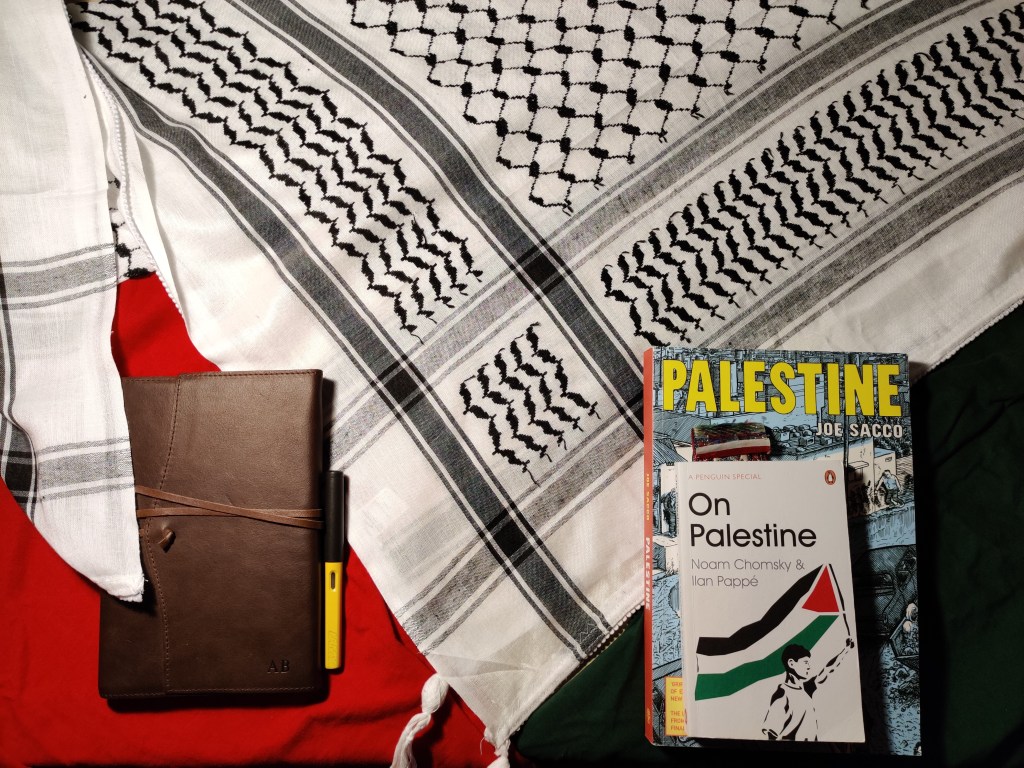
Image by me
“Last month, several Zionist groups raised outcry at an incident on Northwestern campus, in which a student op-ed on Jewish pride was posted around campus with the phrase “From the River to the Sea, Palestine will be Free” painted on it in prominent red letters. The Jerusalem Post accused it of being a “use of hateful rhetoric and [a] public, targeted attack on Jewish identity”: in other words, yet another example of unsolicited antisemitic violence from pro-Palestinian activists on an American University campus.
Two important and problematic claims require unpacking here: first, that this public statement was an uncalled-for escalation, and secondly (in a very linked point) that the phrase itself is inherently antisemitic.
The first claim falls apart with a reading of the original article. The piece itself is a beautiful expression of the author’s Jewish pride, and her refusal to meter it in a world that ever seeks to silence and oppress it. It ends with an attempt to reach over the table: to invite those who may oppose her to engage with her, and even to come to a Shabbat dinner with her to better understand her point of view. Especially as a student coming from a country where Jewish culture is much less pronounced, I especially have felt lucky to be able to come to a place like Penn and be able to understand that culture better, and truly appreciate those like her who are willing to let me into their world.
However, her article contains a key caveat, which her Zionist supporters seized on: she calls out the phrase “From the River to the Sea” as “a rallying cry to destroy the entire State of Israel and all of its Jewish inhabitants”. This is the phrase that pro-Palestine activists had emphasised in their response, but an aspect of her piece that had been emphatically ignored by the articles that came out condemning the response to it.
The second claim, which the author also made in her piece, is a much more contentious one that requires deeper scrutiny. Nonetheless, I believe that it mistakenly mischaracterises the entire Palestinian movement and its allies in a manner which aims to paint them as hateful antisemites. The truth is far from this narrative.
The Anti-Defamation League, an organisation which has been increasingly accused of bullying Anti-Zionist groups and wrongfully accusing them of white supremacy, defines “From the River to the Sea” as a phrase defined by most of its proponents as a call for the destruction of Israel and its people. They provide essentially no evidence for this claim. Now, while I’m sure that far too many examples in which individuals have twisted the phrase into this horrible meaning—the Anti-Zionist movement in my own country has faced deep issues with antisemitism very recently—to define this entire movement in this fashion is strongly mischaracterising it. The phrase itself has existed since long before its sub-group of antisemitic adopters. In itself, it calls for a Palestine made whole again: free from the settler-colonialist violence that plagues it and has already killed almost 150 this year, and continues to create and enforce illegal settlements in violation of international law. That Palestine need not be exclusive of Jewish people. Quite the opposite: I believe as much in their right to settle in their ancestral homeland as much as I support Palestinians’ right to return to theirs. But today’s Palestine is characterised by an enforced partition that keeps its citizens from their families, their religious sites and their ancestral homes, and most of all keeps everyone from any sort of lasting, mutual peace. At best, Palestinian ideas of peace requiring throwing Israelis into the sea are outdated; at worst, they have been created and perpetuated by Israeli media.
I’m not attempting to claim that things would be perfect if the roles were reversed and Palestine held all of the power. I’m sure, in fact, that the result could easily involve as intense, if not worse, discrimination against Jewish people. But such caveats cannot permit the current state of unbalanced violence that exists today: not standing up against it would be a betrayal of our morals and our activism.
This mischaracterisation stretches to Penn, too: a Jewish friend of mine told me lately how she had to explain to a passerby that the display of a Palestinian flag on campus was not, in fact, a flagrant display of antisemitism. For a campus and community that stands so strongly for progressive values, it saddens and angers me that were able to be blinded by such naivety over an issue that is so pressing and so lopsided.
I am not Jewish. Nor am I Palestinian. Yet due to this precedent, I feel scared to use my voice in support of Palestine, for fear of my words and my character being twisted into something that I stand as much against as I do Israel’s mistreatment of the Palestinian people. My stance against Zionism in its current state is unequivocally exclusive from my absolute opposition to antisemitism in its increasingly prevalent, multi-faceted and vicious forms. I am tired of the two being convoluted.
That said, I am deeply committed to open dialogue on this incredibly important issue. Please send me an email, a DM, or an invitation to dinner—over my table or especially over yours. Resolution and peace are built over an approach built on understanding, not on division. If you’ve read this far, then I thank you for lending me your ear. Now please let me lend you mine.”
—27/11/2022 – 19/10/2023
 AB
AB 